
Walking Into History:
The Little Rock Crisis and the Fight to Desegregate Schools
Texas TEKS: Readiness Standards
US.9(A) Trace the historical development of the civil rights movement from the late 1800s through the 21st century, including the 13th, 14th, 15th, and 19th amendments. • US.9(B) Explain how Jim Crow laws and the Ku Klux Klan created obstacles to civil rights. • US.9(G) Describe presidential actions and congressional votes to address minority rights, including desegregation of the armed forces, the Civil Rights Act of 1964, and the Voting Rights Act of 1965.
Measurable Objective (SWBAT)
Students will be able to trace the legal and social obstacles to school desegregation from Plessy v. Ferguson (1896) through the Little Rock Crisis (1957) and evaluate the role of federal authority in enforcing Brown v. Board of Education, citing at least two primary sources as evidence.
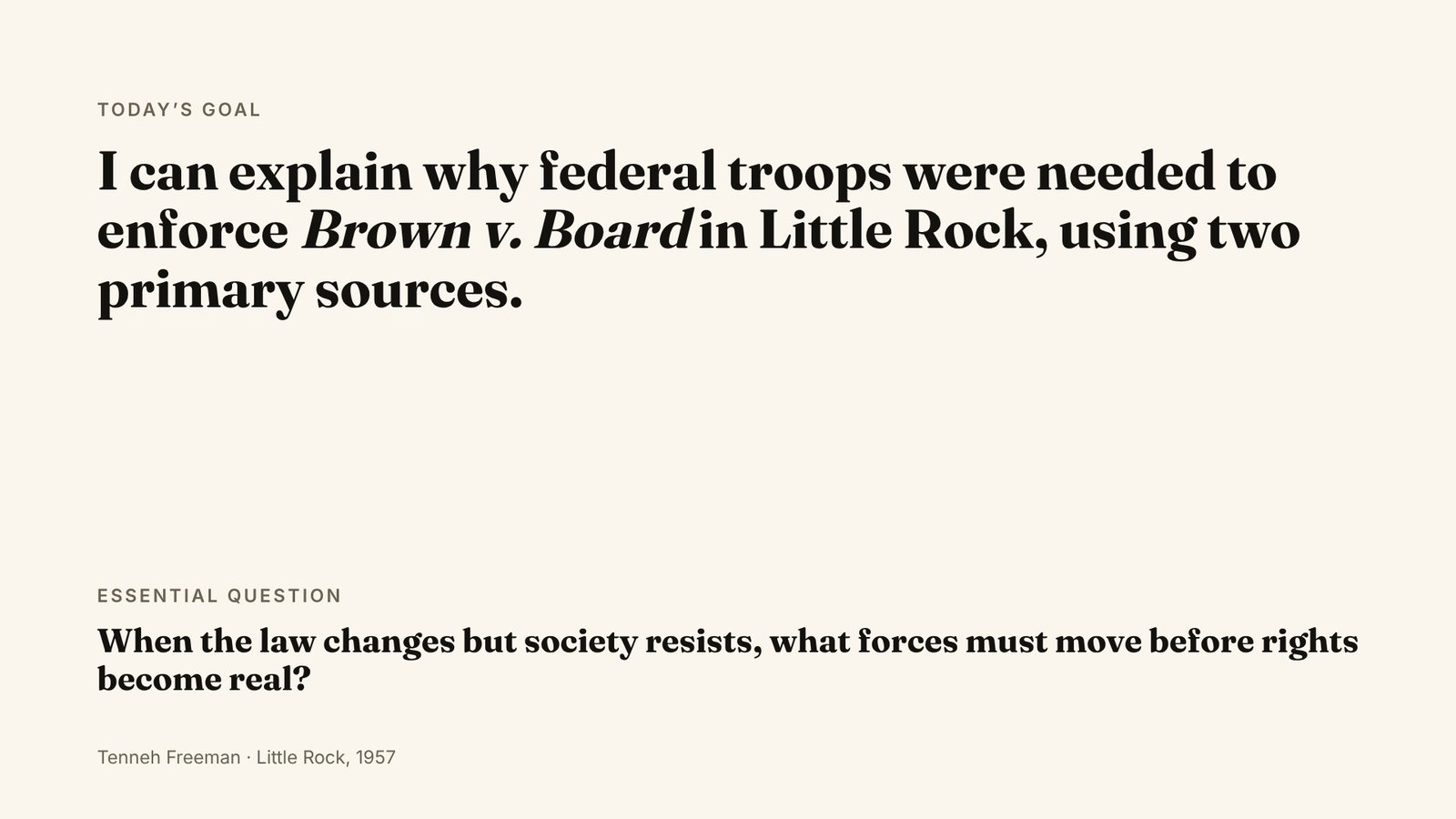
When the law changes but society resists, what forces must move before rights become real?
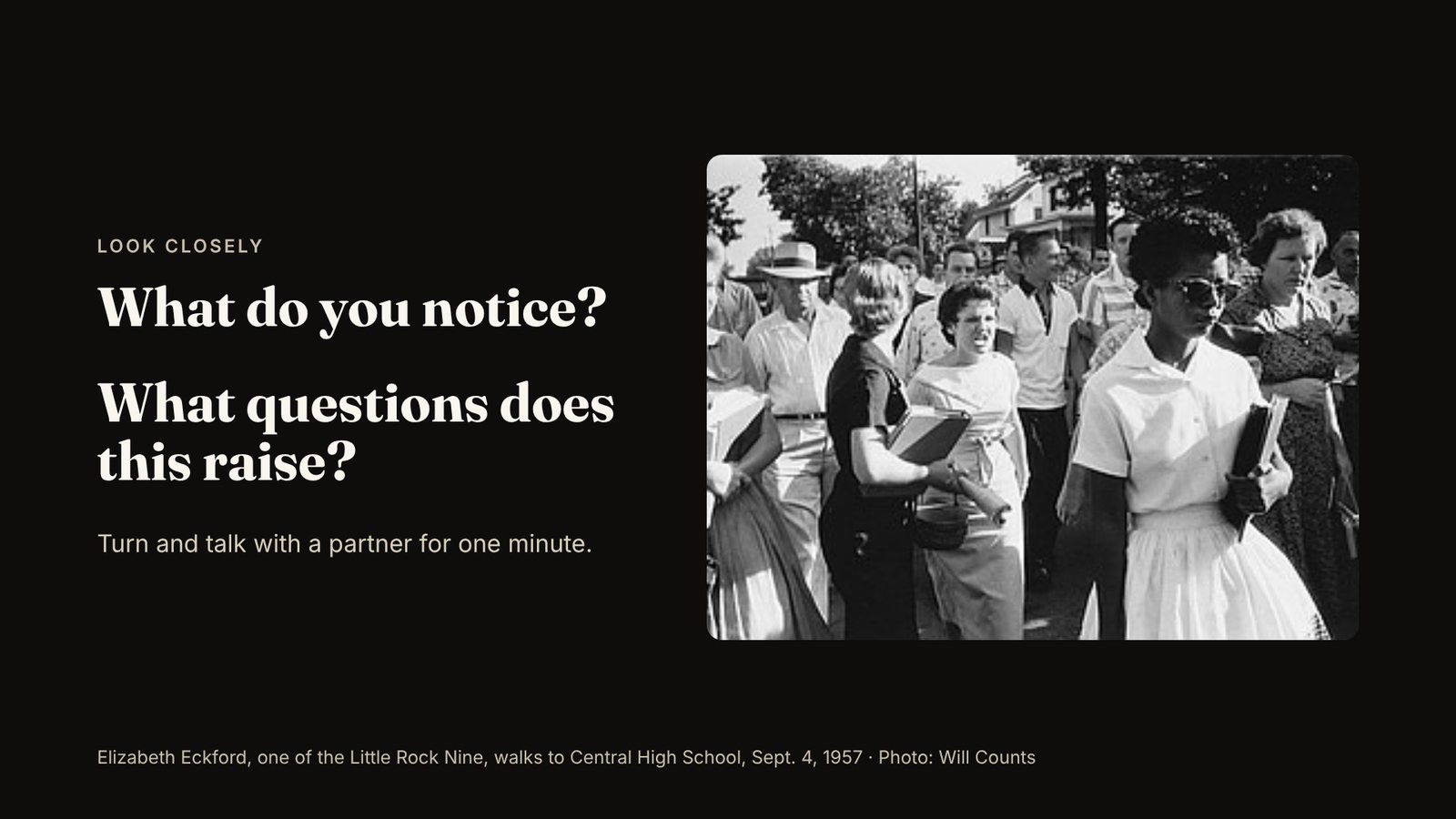
- Photo: Elizabeth Eckford walking to Central High, Sept. 4, 1957
- Excerpts: Plessy v. Ferguson (1896) & Brown v. Board (1954)
- Timeline graphic organizer (3-tier scaffold)
- Eisenhower's televised address, Sept. 24, 1957
- Exit ticket (half-sheet)
Lesson Procedure
| Phase | Time | Activity | Teacher Move |
|---|---|---|---|
| Hook / Bell Ringer | 10 min | Display the photo of Elizabeth Eckford walking to Central High in her white blouse and skirt. Prompt: "What do you notice? What questions does this image raise?" Turn-and-talk, then cold call 2-3 students. | Resist naming context. Let students generate questions. Chart their questions on the board - return to them at closure. |
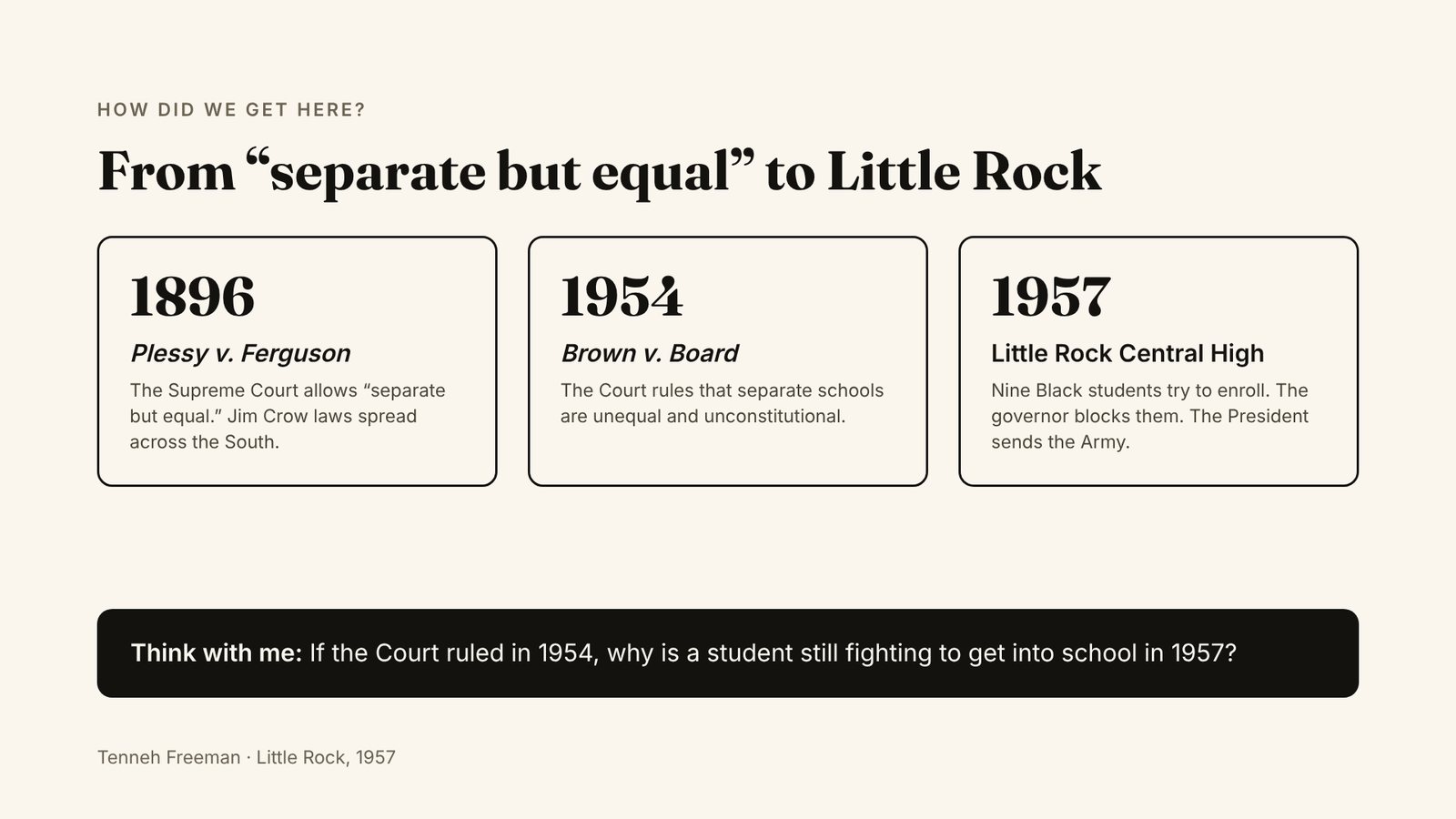
| Direct Instruction | 15 min | Mini-lecture: Plessy v. Ferguson → "separate but equal" doctrine → NAACP legal strategy → Brown v. Board (1954). Students annotate a two-column chart: Law / Reality on the ground. | Think aloud: "I'm asking: if the Court ruled in 1954, why is a student still fighting to enter a school in 1957?" Pause and let students answer before continuing. |
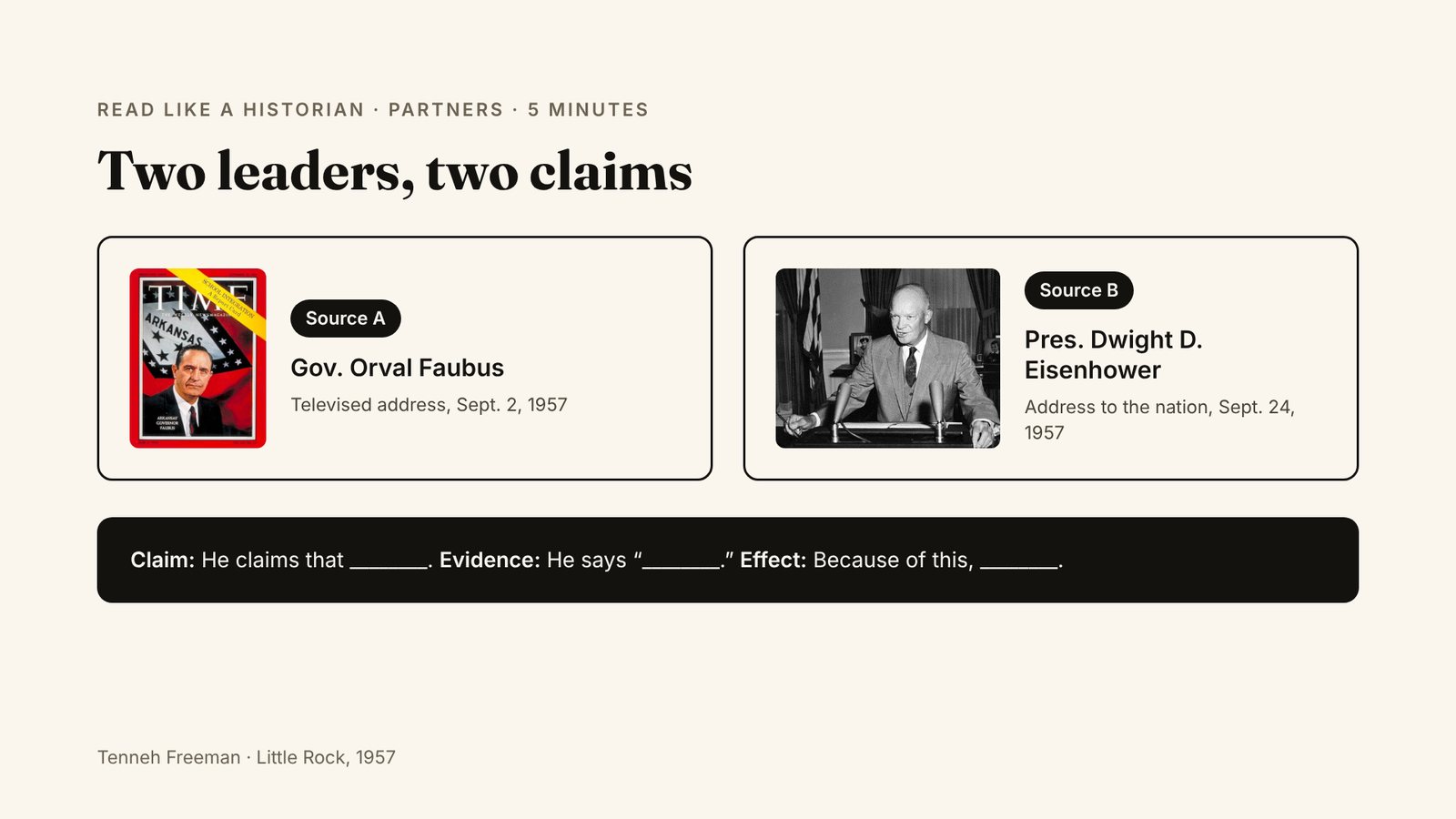
| Primary Source Analysis | 25 min | In pairs, students read excerpts from (A) Governor Faubus's televised address and (B) Eisenhower's response. Graphic organizer: Claim → Evidence → Effect. Groups share out on a class T-chart (state resistance / federal response). | Circulate. Target misconceptions: "What does it tell us that the President had to send the Army?" Push students to connect to US.9(G). |
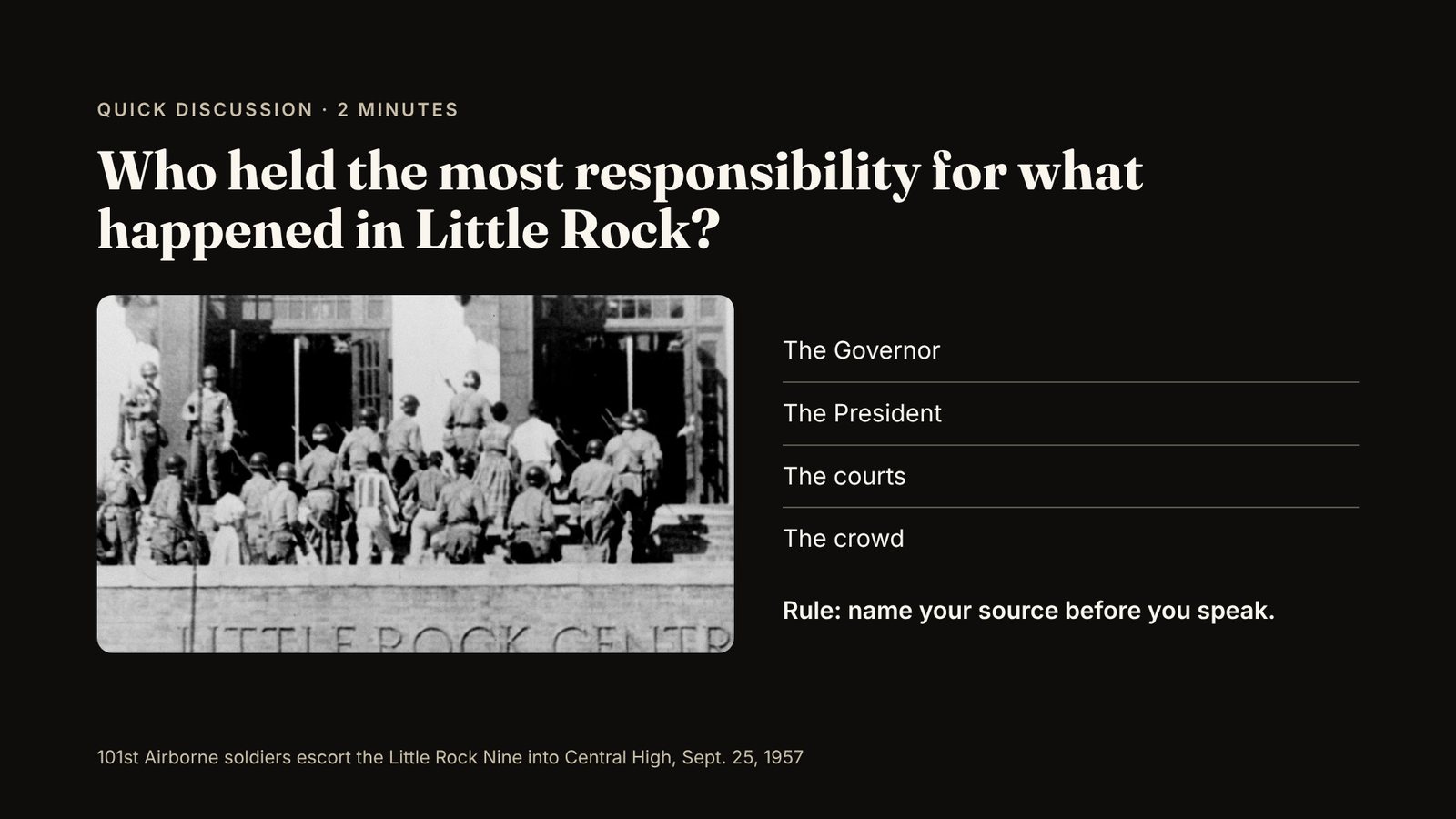
| Structured Discussion | 20 min | Socratic seminar (inner/outer circle): "Who holds the most responsibility for what happened in Little Rock - the Governor, the President, the courts, or the citizens in the crowd?" Each speaker must reference a source before speaking again. | Do not take a side. Redirect with "What does your source say about that?" Outer circle uses an observation protocol. |
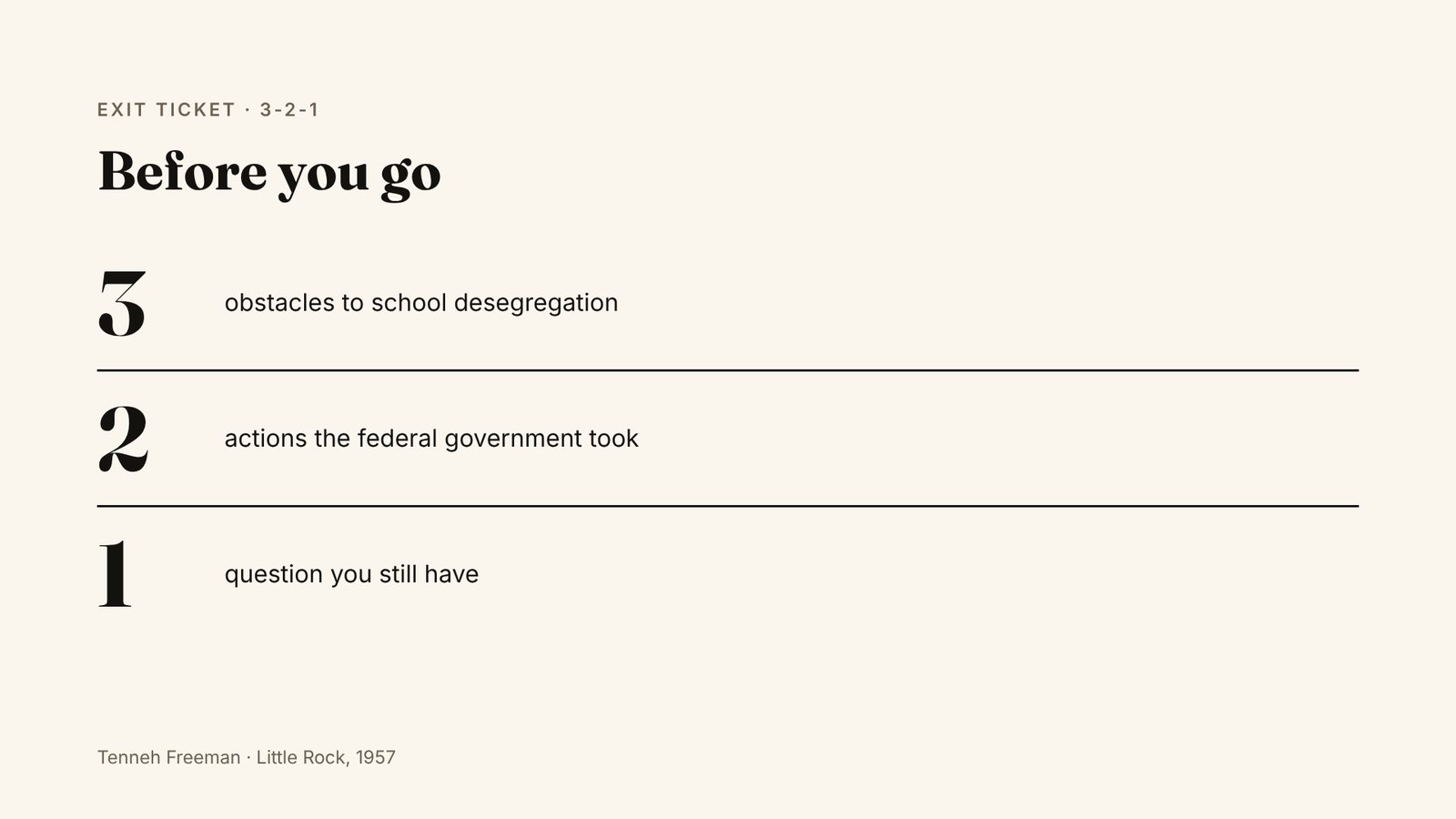
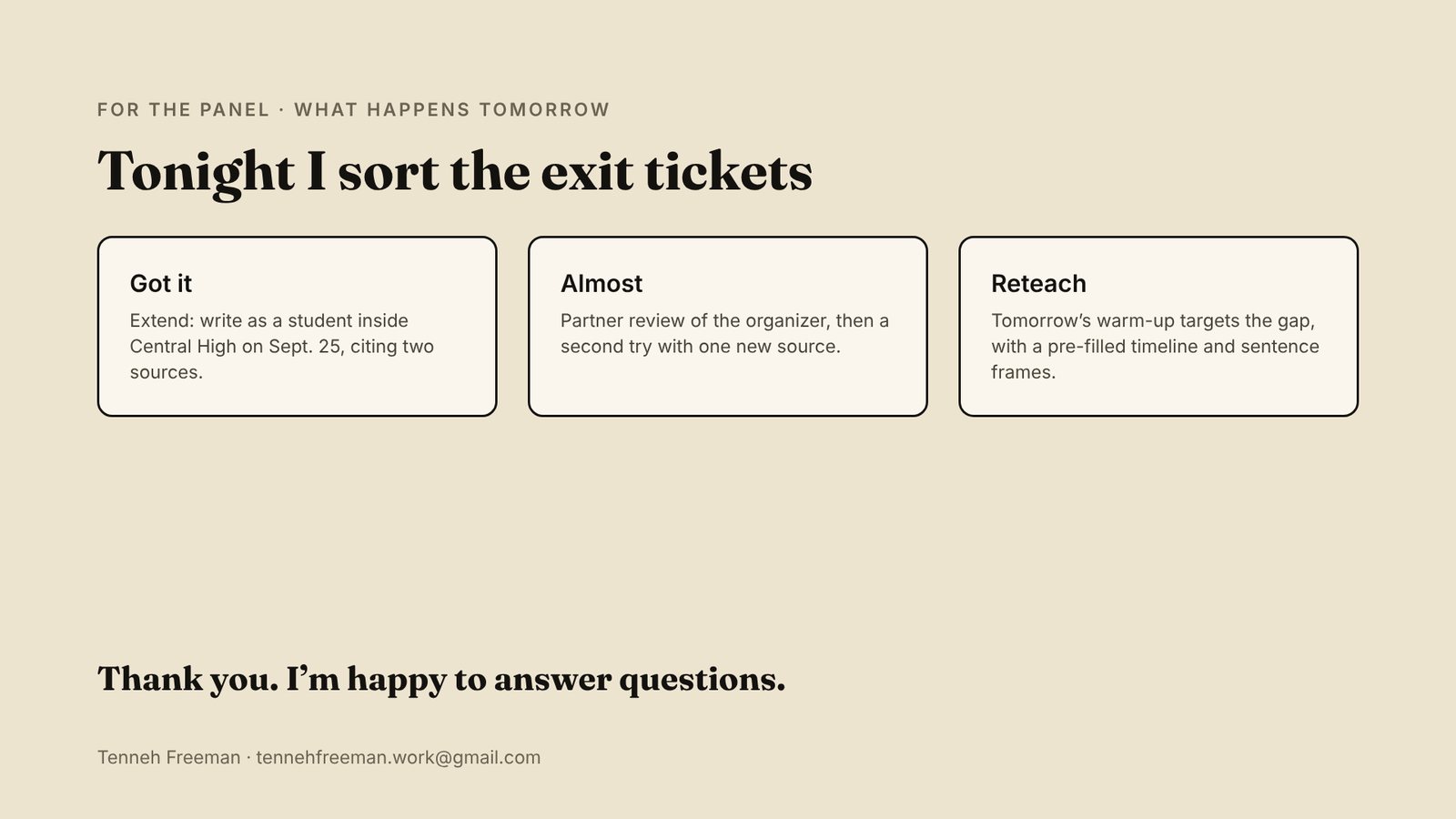
| Closure / Exit Ticket | 20 min | Return to the bell-ringer questions. Which ones can students now answer? Exit ticket (3-2-1): 3 obstacles to desegregation, 2 federal actions taken, 1 question still unanswered. | Collect tickets - sort into 3 piles (got it / almost / reteach) before next class. This drives tomorrow's opening. |
Differentiation
Scaffold
Pre-completed timeline with key dates; sentence frames for the graphic organizer; glossary of legal terms (Plessy, injunction, federalize); partnered reading with highlighted excerpts.
On Level
Standard graphic organizer; full primary source excerpts; Socratic seminar with observation protocol; unaided exit ticket.
Extend
Compare Eisenhower's Little Rock action to a later desegregation case; draft a one-paragraph response from the perspective of a student inside Central High on Sept. 25, 1957, citing two sources.
Assessment
From Colony to Country:
African Independence Movements and the Rise of Nationalism
Texas TEKS: Readiness Standards
WH.13(E) Summarize the rise of independence movements in Africa, the Middle East, and South Asia and their leaders, including Jomo Kenyatta, Kwame Nkrumah, and Mohandas Gandhi. • WH.8(B) Identify the major political, economic, and social motivations that influenced European imperialism. • WH.8(C) Explain the major characteristics and impact of European imperialism.
Measurable Objective (SWBAT)
Students will be able to summarize the rise of African independence movements by identifying at least two leaders (Nkrumah, Kenyatta) and connecting the legacy of European imperialism to the conditions that made nationalism necessary, using a completed cause-and-effect organizer as evidence.
How do people reclaim identity and governance after decades of colonial rule, and what does that process cost?
- Side-by-side maps: colonial Africa (1914) vs. independent Africa (1975)
- Leader profiles: Kwame Nkrumah (Ghana), Jomo Kenyatta (Kenya)
- Excerpt: Ghana Independence Speech, Nkrumah, 1957
- Cause-and-effect graphic organizer (3-tier scaffold)
- Exit ticket: identification + significance
Lesson Procedure
| Phase | Time | Activity | Teacher Move |
|---|---|---|---|
| Hook / Bell Ringer | 10 min | Display both maps side by side. Prompt: "What changed between 1914 and 1975? What questions do these maps raise about how this change happened?" Students write three observations, share with a partner. | Ask: "What's missing from the 1914 map that is everywhere on the 1975 map?" Guide to: African names, African borders drawn differently, African leadership. |
| Context Building | 15 min | Brief review of WH.8(B)/(C): What were the political, economic, and social motivations behind European imperialism? Students use vocabulary: raw materials, colonialism, partition, nationalism. Partner quiz on key terms before proceeding. | Check vocabulary retention - do not proceed to independence movements until students can name at least two imperialist motivations. Reteach quickly if needed. |
| Leader Profile Jigsaw | 25 min | Expert groups: half study Nkrumah (Ghana, 1957), half study Kenyatta (Kenya, 1963). Each group completes: Who / Background / Strategy used to gain independence / What changed after independence. Regroup: teach partner from the other country. Complete a comparison chart together. | During expert phase, push past surface: "What did Nkrumah mean by 'political independence is only the beginning'?" This is the complexity a hiring committee wants to see. |
| Cause and Effect Analysis | 20 min | Whole class builds a graphic organizer: Cause (imperialism's political, economic, social effects) → Condition (new African identity, economic exploitation, political exclusion) → Movement (nationalist leaders, strategies) → Effect (independence, new borders, ongoing challenges). Students add one detail from their jigsaw to each column. | Project the blank organizer. Cold call to fill it in. Push for evidence: "Which leader showed us that?" Narrate your thinking about causal relationships. |
| Closure / Exit Ticket | 20 min | Exit ticket: Name one leader, their country, one strategy they used, and one lasting effect of independence. Sort tickets at the door: mastered / needs re-teach on leader / needs re-teach on cause-effect. | Acknowledge: "Some countries gained independence but faced new challenges - we explore those next week." Leave the tension open for the next lesson. |
Differentiation
Scaffold
Pre-labeled cause-and-effect organizer with sentence starters; leader profiles condensed to key bullets; vocabulary anchor chart with images; jigsaw partner assigned strategically.
On Level
Standard profile texts; blank organizer; jigsaw teaching protocol; unaided exit ticket with four components.
Extend
Research a third leader not covered in class (e.g., Leopold Senghor, Sekou Toure); evaluate which strategy - negotiation vs. militant resistance - proved more effective long-term, with evidence.
Assessment
Place, People, and Culture:
The Human Geography of Sub-Saharan Africa
Texas TEKS: Readiness Standards
WG.2(A) Describe the human and physical characteristics of the same regions at different periods of time to analyze relationships between past events and current conditions. • WG.17(A) Describe and compare patterns of culture such as language, religion, land use, education, and customs that make specific regions of the world distinctive. • WG.8(A) Compare ways that humans depend on, adapt to, and modify the physical environment, including the influences of culture and technology.
Measurable Objective (SWBAT)
Students will be able to describe and compare patterns of culture across at least two sub-regions of Sub-Saharan Africa, including language, religion, land use, and human-environment interaction, and analyze how past conditions continue to shape current geographic realities, using a completed region-comparison organizer as evidence.
When we say a region is "the same" across time but "different" across its cultures, what are we actually seeing, and what are we missing?
- Political map of Sub-Saharan Africa (current)
- Language/ethnic group overlay map
- Photo gallery: 6 images across West, East, and Southern Africa
- Region-comparison organizer (3-tier scaffold)
- Human-environment interaction case study (West Africa: agriculture & deforestation)
- Exit ticket: region identification + one WG.8(A) connection
Lesson Procedure
| Phase | Time | Activity | Teacher Move |
|---|---|---|---|
| Hook / Bell Ringer | 10 min | Show six photographs, no labels. Three from the same sub-region, three from a very different one. Prompt: "Sort these into two groups. What patterns helped you decide?" Gallery walk: students post sticky-note observations. | After sorting, reveal the geographic context. Ask: "What physical or cultural clues told you these belonged together?" Bridge to WG.17(A): patterns of culture. |
| Map Analysis | 15 min | Layer political map over language/ethnic group map. Key question: "What do you notice about how political borders and cultural boundaries do or do not match?" Students annotate their own maps: circle three places where they don't align. Pair-share findings. | Introduce WG.2(A): describe the same region at different periods. Ask: "These borders were drawn by colonial powers. How might that explain the misalignment?" Connect backward to imperialism. |
| Sub-Region Deep Dive | 25 min | Assign sub-regions: one-third of class → West Africa, one-third → East Africa, one-third → Southern Africa. Each group completes the region organizer: Physical features · Major language families · Dominant land uses · How people adapt to/modify the environment (WG.8A). Groups present their region using map and one photograph. | During West Africa presentations: draw on your own knowledge of the region when appropriate. A teacher who has lived in West Africa brings irreplaceable authenticity. Name it without dominating. |
| Case Study: Human-Environment Interaction | 20 min | Short reading: deforestation and subsistence farming in coastal West Africa. Students apply WG.8(A): how are people depending on, adapting to, and modifying the environment? Add one row to their organizer. Whole-class debrief: compare how different sub-regions interact with their environments differently. | Ask: "Is modifying always negative? What would the community lose if they stopped?" Push toward nuanced thinking, not a simple conservation vs. development binary. |
| Closure / Exit Ticket | 20 min | Exit ticket: name your sub-region, one cultural pattern that makes it distinctive (WG.17A), and one way people interact with the physical environment (WG.8A). Students may use their organizer. | Sort: can identify sub-region + cultural pattern / can do one but not both / cannot yet differentiate. Address the middle group at the start of next class before moving to East/Southern Africa individually. |
Differentiation
Scaffold
Pre-labeled maps with sub-region boundaries highlighted; partially completed organizer with sentence frames; photo labels provided; case study condensed to key paragraph with guiding questions.
On Level
Blank organizer; standard map; case study reading with two guiding questions; unaided exit ticket citing two TEKS-specific skills.
Extend
Select one country within your sub-region and compare its cultural patterns at two points in time (pre-colonial, post-independence). Use WG.2(A) to analyze what changed and what remained. Cite one primary and one secondary source.
Assessment
Walking Into History:
Little Rock, 1957
Texas TEKS: Readiness Standards
US.9(B) Explain how Jim Crow laws and the Ku Klux Klan created obstacles to civil rights. • US.9(G) Describe presidential actions and congressional votes to address minority rights, including desegregation of the armed forces, the Civil Rights Act of 1964, and the Voting Rights Act of 1965.
Objective (student-friendly)
I can explain why federal troops were needed to enforce Brown v. Board in Little Rock, using two primary sources as evidence.
This is my 90-minute US History lesson cut to a 15-minute sample teach. It keeps the five parts a principal looks for: a clear objective, a hook, primary sources, every student talking, and a quick check for understanding.
The Slides

15-Minute Plan
| Phase | Time | Activity | Teacher Move |
|---|---|---|---|
| Hook | 2 min | Show the photo of Elizabeth Eckford walking to Central High, Sept. 4, 1957. Prompt: "What do you notice? What questions does this raise?" Turn and talk. | Don't explain the photo yet. Write two student questions on the board to answer at the end. |
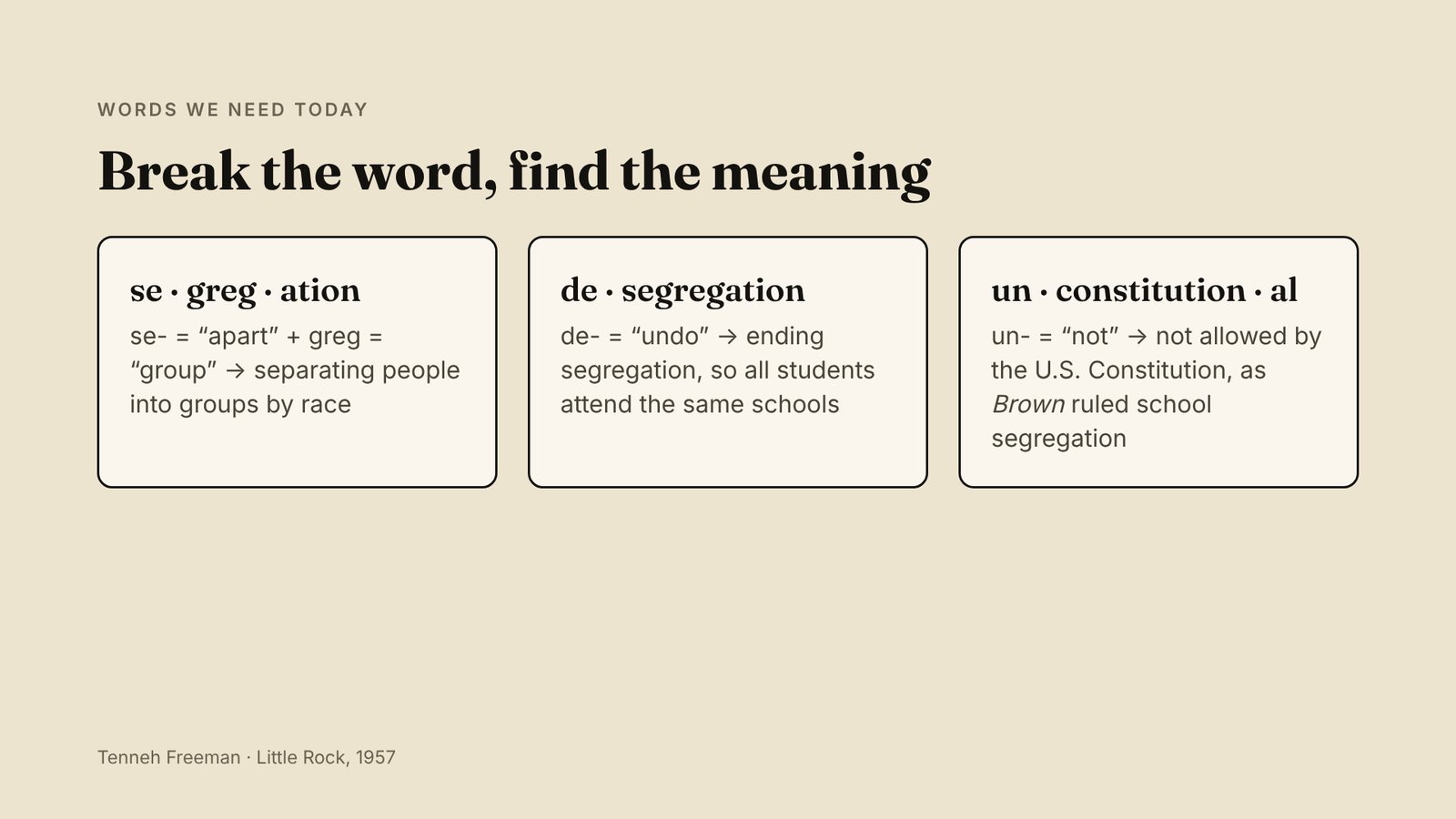
| Mini-Lesson | 2.5 min | Timeline: Plessy (1896) → Brown (1954) → Little Rock (1957). Students fill a two-column chart: Law / Reality. Preview three words by their parts: segregation, desegregation, unconstitutional. | Think aloud: "If the Court ruled in 1954, why is a student still fighting to get into school in 1957?" Pause for answers. |
| Source Pairs | 5.5 min | Partners read Gov. Faubus (Sept. 2, 1957) and Pres. Eisenhower (Sept. 24, 1957) and complete Claim → Evidence → Effect with sentence frames. | Circulate: "What does it tell us that the President had to send the Army?" |
| Discussion | 2.5 min | "Who held the most responsibility: the Governor, the President, the courts, or the crowd?" Rule: name your source before you speak. | Stay neutral. Redirect with "What does your source say about that?" |
| Closure | 2.5 min | Return to the hook questions, then the 3-2-1 exit ticket: 3 obstacles, 2 federal actions, 1 question. | Sort tickets into got it / almost / reteach. Tomorrow's warm-up targets the reteach group's biggest gap. |
Supports Built In
- Key lines highlighted in each source
- Hard words defined under each excerpt
- Sentence frames for Claim, Evidence, and Effect
- Word-parts instruction for unit vocabulary
- Notice and wonder warm-up
- Law vs. Reality chart during the mini-lesson
- Organizer checked while partners work
- 3-2-1 exit ticket sorted for tomorrow's reteach